
Key takeaways
- Common lawn weeds like chickweed can be managed with targeted weed control.
- Prevent crabgrass with pre-emergent herbicides early in the growing season.
- Professional lawn care services help maintain a healthy lawn year-round.
If you live in Virginia, you’ve likely seen more than one weed pop up where it doesn’t belong.
These common weeds can spread fast, pushing out healthy turf and making your lawn look thin or patchy.
But with the right approach, weed control doesn’t have to feel overwhelming.
In this post, we’ll cover seven lawn weeds that show up often in Virginia. You’ll learn how to spot them by their leaves, root systems, or flowers, and how to stop them from spreading.
From common chickweed with its tiny white flowers, to fast-spreading crabgrass and hard-to-kill dandelion, we’ll walk you through what works.
We’ll talk about how to improve drainage, when to try lawn aeration services, and how overseeding can help crowd out weeds before they take hold.
You’ll also get tips on using safe and targeted treatments to knock back weeds like wild violet, hairy bittercress, and ground ivy without harming your soil or grass.
With a few changes and steady care, your lawn can get back on track and stay healthy through every growing season.
Common weeds in Virginia that you should know about
1. Chickweed
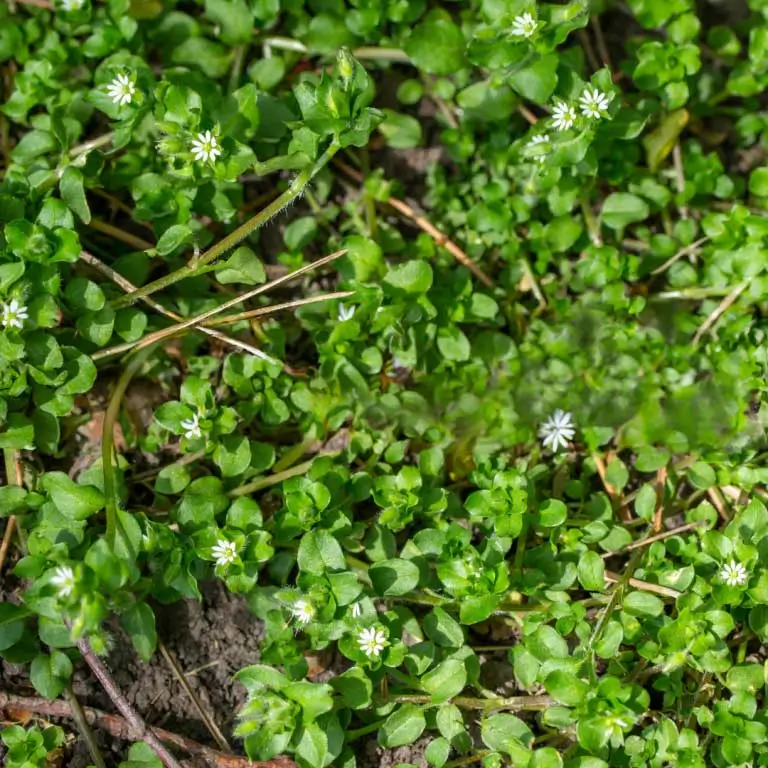
Chickweed is a soft, low-growing plant that spreads fast and covers ground quickly.
It’s one of those common weeds in Virginia that pop up when the soil stays cool and moist.
If your lawn is thin or patchy, this weed takes it as an open invitation.
You can spot common chickweed by its small white flowers, which look like tiny stars. They usually bloom in early spring or late fall.
Its light green leaves are shaped like ovals and grow in pairs. The stems are delicate and may have a bit of fuzz on them.
It tends to grow in clusters and stays close to the ground, making it easy to miss until it’s spread out across your turf.
This broadleaf weed thrives in shady, damp areas. It’s an annual weed, which means it lives for just one growing season, but that’s enough time for it to spread out and crowd your lawn.
When left alone, chickweed can choke out desirable plants, especially in thin lawns or places with poor drainage.
Getting rid of chickweed takes a steady approach. Hand-pulling works if the patch is small, but you have to get the entire root system, or it will grow back.
For larger areas, a weed control product designed for broadleaf plants can help.
These are often susceptible to many herbicides, so make sure you apply them during active growth, typically early spring or fall.
2. Crabgrass

Crabgrass is one of the most common weeds in Virginia. It pops up in thin, bare spots in your lawn, especially when the soil is warm and the grass isn’t thick enough to block it.
This annual weed grows fast in late spring and early summer, then sticks around through the heat. It spreads low and wide, forming a clump that pushes out desirable plants.
You can spot crabgrass by its light green color and wide, flat blades. It looks different from the rest of your grass, so weed identification is usually pretty easy.
It tends to grow close to the ground, which makes mowing over it mostly useless.
If left alone, it’ll drop thousands of seeds before dying off when the fall frost hits. Those seeds lie dormant in your soil and germinate again the next year.
To control weeds like crabgrass, timing matters. The best way to deal with it is to stop it before it starts.
Use a weed control product made for crabgrass in early spring, right before the seeds begin to sprout. These are called pre-emergent.
If you wait too long, the seeds will already be growing.
If crabgrass has already shown up, post-emergent sprays can help, but they’re not always perfect.
These sprays work better when the weed is still young. Once it’s mature, it becomes difficult to control.
3. Ground Ivy

Ground ivy is a creeping perennial weed that’s often found in shady spots where the turf is thin. Some people call it creeping Charlie.
It spreads fast, crawling along the ground and rooting at every node. The plant has square stems, toothed leaves, and small purple flowers that show up in early spring. It gives off a strong smell when crushed.
This broadleaf weed tends to take over when the lawn is weak, shaded, or fertilized at improper times.
It grows close to the ground, which makes mowing useless against it. Its thick mats block out desirable plants and can smother nearby grass.
You can spot ground ivy by its rounded leaves with scalloped edges. The leaves grow in pairs and often form a rosette pattern.
The plant has a hairy texture, especially on the stems. It loves areas with low soil fertility and low pH, and it thrives in moist conditions with poor drainage.
Getting rid of ground ivy takes effort. Most basic herbicides don’t work well on it. It’s one of those weeds that’s difficult to control and often susceptible to many herbicides, only when applied at the right time.
For the best results, apply a weed control product with dicamba or triclopyr in the fall, when the plant is storing nutrients in its root system. That’s when it’s most vulnerable.
4. Dandelions

Dandelions are easy to spot in Virginia lawns, mostly because of their bright yellow flowers and tall stalks that rise above the grass.
They’re one of the most common weeds in Virginia, and they can be stubborn. This broadleaf weed is a perennial, which means it comes back year after year unless you get the entire root system out.
The leaves grow in a rosette at the base, and they’re deeply toothed, giving them that jagged shape people recognize.
The flower heads eventually turn into white puffballs full of dandelion seeds, which the wind carries everywhere. That’s how the weed spreads so easily.
Dandelions tend to show up in thin lawns, especially where the soil is low in nutrients or compacted.
They thrive in sunny spots but can also handle some shade. The long taproot helps them survive dry spells, and they’ll push back even after mowing.
If you want to get rid of weeds like dandelions, it takes a mix of timing and the right tools. Digging them out by hand works, but only if you remove the full root. Otherwise, they grow back.
For larger areas, use a weed control product designed for broadleaf types. Apply it when the plant is actively growing, usually in early spring or late fall. That’s when the sap is moving down to the root, and the spray can reach deep enough to work.
5. Wild Violets

Wild violets are low-growing, cool-season perennial weeds that pop up in many Virginia lawns.
Their heart-shaped oval leaves and purple or violet flowers might look nice at first. But once they take hold, they spread fast. These plants love shade and damp soil, and they tend to stick around if left alone.
The leaves form a rosette at the base and often grow in thick patches. The flowers have five petals and show up in early spring, sometimes even before your grass starts growing. While they may look delicate, wild violets are tough.
They form thick roots, called rhizomes, that help them thrive and bounce back after mowing or pulling.
You’ll mostly find them in thin lawns, especially in spots with low pH or poor drainage.
They’re also common in shaded areas where grass struggles to grow. And once they settle in, wild violet patches become difficult to control.
If you want to get rid of weeds like these, hand-pulling works in small areas, but it’s not easy. You need to remove the whole root system, or they’ll grow right back.
For larger patches, a weed control product with triclopyr works best. Apply it when the plants are growing, usually in late spring and early summer, or again in the fall.
6. Clover

White clover is one of those common lawn weeds that shows up in both sunny and shady yards across Virginia lawns.
It’s a perennial that spreads by creeping stems, forming small patches that quickly connect into larger ones.
Each clump has three round, light green leaflets, sometimes marked with a pale stripe. In bloom, it shows tiny white flowers that bees love.
Clover grows low and steady. It hugs the ground and holds tight in place, which makes it tough to mow away.
It thrives in areas with low soil fertility, especially where nitrogen is missing. That’s why it often shows up in thin lawns that have been fertilized at improper times or left alone too long.
This broadleaf weed has a shallow root system, which makes hand-pulling possible if the patch is small.
But it spreads fast, especially in bare or weak turf. The plant can germinate quickly and start growing early in the growing season, holding its spot through summer.
To get rid of weeds like clover, use a weed control product labeled for broadleaf types. Look for mixes that include dicamba or MCPP, which are more effective against clover than basic sprays.
Apply in late spring and early summer when the plant is actively growing. If it keeps coming back, apply again in fall.
7. Thistles

Thistles are one of those weeds that people remember. They’re spiky, tough, and hard to ignore.
These broadleaf plants have sharp leaves with a toothed edge and a tough stem that stands tall above the turf.
Many types have purple or pink flowers, and most grow from a rosette at the base. While they may look interesting, thistles are a weed that no one wants in a lawn.
Most thistles are perennial weeds, which means they’ll come back year after year unless you get to the root. Their deep root system helps them survive drought and mowing.
Once they settle in, thistles can thrive even in areas with low soil quality or poor drainage. These weeds often show up in thin lawns where grass struggles to grow.
The sharp spines make thistles unpleasant to walk near, and they crowd out desirable plants.
They grow quickly and can form a dense clump if left alone. That’s why weed control needs to happen early in the growing season before they flower and drop seeds.
To get rid of weeds like thistles, you’ll need more than just pulling them. Digging them out by hand works if the patch is small, but you have to remove the full taproot.
For larger infestations, use a weed control product labeled for broadleaf weed types. Products with 2,4-D, dicamba, or clopyralid are more effective on thistles.
Spray in early spring when growth is still low or again in fall when the plant pulls energy into its roots.
The most effective ways to deal with common weeds
No matter which common weeds in Virginia you’re dealing with, the steps to control them often come down to the same core habits.
A few simple, steady lawn care practices make the biggest difference over time.
Start with a soil test. Many lawn weed problems come from poor soil health or low pH.
You can get help from soil sampling services to understand exactly what your soil needs. When you adjust your soils to an appropriate pH and feed your grass the right nutrients, weeds have less space to thrive.
Some weeds prefer areas with low soil fertility, so addressing this early helps more than any spray.
Next, make your grass stronger. That means calling a lawn aeration service to improve drainage, especially in compacted areas.
You can also try overseeding in the fall to fill in thin spots and crowd out broadleaf weed types that sneak in where grass is weak.
Watering at the right times, and not fertilizing at improper times all add up to a thicker, healthier yard.
In spots where weeds are already growing, manual removal can work if the root system is shallow.
Look for options labeled for broadleaf or perennial weed types and apply during the right part of the growing season, like early spring or fall.
But for deeper or more stubborn types like ground ivy, wild violet, or thistle, you’ll want a good weed control services provider.
You can also check out what lawn care companies use to kill weeds if you want a closer look at what actually works.
And when things get out of hand, reliable lawn care services can help you reset the yard and start clean.
Even the most difficult to control weeds can be pushed back with the right mix of care, timing, and products.
If you want to control weeds, the best place to start is by taking care of the grass first. That’s how you keep your lawn full and free of the weeds that are all too common in Virginia.